
Prophecies After Dinner
The Chronicles of Narnia: Chapter 8

Earlier this year I wrote about why I secretly hated the Chronicles of Narnia as a child. In it, I made a promise to read and review all seven books, so as to see if my childhood memories fit the actual quality of the stories. And so I dusted off my old, single-volume Brazilian edition from the shelf and began reading. This week, we continue to explore The Lion, the Witch, and the Wardrobe, Chapter Eight: “What Happened After Dinner”.
We left the Pevensie children just after meeting Mr. Beaver and learning about Aslan — that name around which the entirety of the Narnia stories revolve.
Mr. Beaver the beaver takes the children to his house, a small building much like a beehive, sitting atop a frozen lake behind a dam (of which Mr. Beaver is quite proud). An entire page is dedicated to the children helping Mr. and Mrs. Beaver make dinner, with exquisite descriptions of food: fried trout, baked potatoes, a jug of creamy milk for each to drink, deep yellow butter, and a “great and gloriously sticky marmalade roll” for dessert. And tea, of course — the greatest sign that the beavers are the good guys is that they drink tea at the proper hours.
This is one of the many “useless” passages in the book: it does not move the plot forward, it does not convey new information, it does not reveal a much about the characters. And yet it is one of the passages with the most Narnia-ness in the whole text. As I said in Part One, coziness is a defining trait of Narnia:
“This coziness is characteristic of Narnia. These are stories of kings and queens, magic and war, but the happiness to be found in them is a homely one, the happiness of old comfortable shoes and the smell of afternoon tea.”
Lewis rightly ends Chapter Seven here, and leaves the bad news for the next one.
What kind of story this is
Mr. Beavers tells our heroes of the dreadful fate of the faun Tumnus: he was taken into the Witch’s house and turned into stone. Lucy and Peter don’t hesitate a moment:
“I don’t doubt you’d save him if you could, dearie,” said Mrs Beaver, “but you’ve no chance of getting into that House against her will and ever coming out alive.”
“Couldn’t we have some stratagem?” said Peter. “I mean couldn’t we dress up as something, or pretend to be — oh, pedlars or anything — or watch till she was gone out — or- oh, hang it all, there must be some way.
Chapter Eight: “What Happened After Dinner”
This is, I think, a deceptively important passage, because it tells us what kind of story we are reading.
So far, the book has been ambiguous as to how much it takes itself seriously. The Witch is dreadful and menacing. But at the same time, the Pevensie children followed the robin because “they’re good birds in all the stories I’ve ever read”, and this is presented as a sensible thing to do. Is this a world in which the menace and consequences are real, or a world that operates by “children’s stories” logic?
Lewis discreetly, but firmly, answers: the first one. The plan Peter comes up with — dressing up as pedlars to infiltrate the Witch’s Castle — is the kind of cartoony plan you would see in certain media, that Home Alone-like, “kids defeating adult criminals” type of story. But that is not the kind of story we are reading right now. Mr. Beaver shoots Peter down quickly. All he would accomplish is leading the four of them straight to the Witch. They must wait. It won’t be them to defeat the Witch, but Aslan Himself.
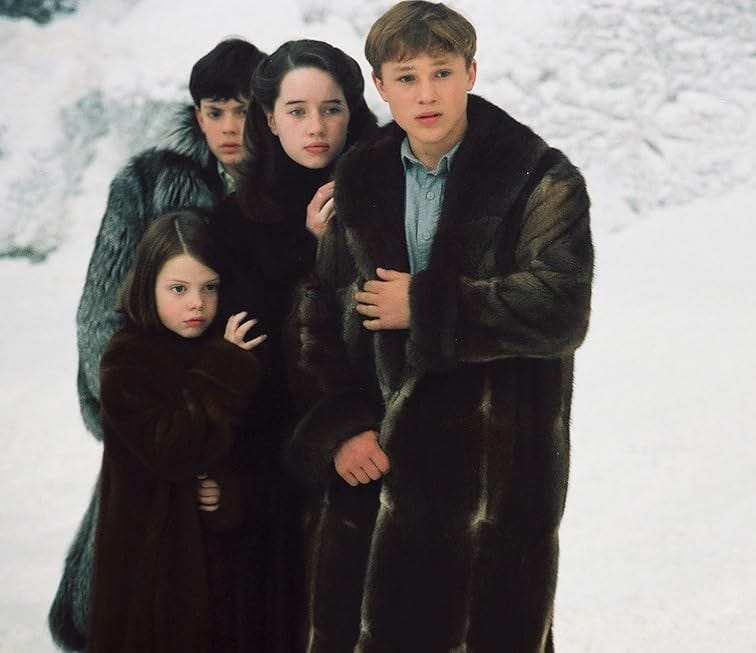
Mr. Beaver finally explains to the children who Aslan is. Edmund asks if the Witch can’t turn the lion into stone, which Mr. Beaver finds an amusingly silly question.
“Turn him into stone? If she can stand on her two feet and look him in the face it’ll be the most she can do and more than I expect of her.”
Peter tell us later that this question is “just the sort of thing [Edmund] would say”, so we can assume the question was made not in good faith (which would be fair, since the children don’t know Aslan yet), but in the gloomy, “always-see-the-bad-side” disposition that has plagued Edmund from Chapter One.
More crucially, this is the last time we hear of Edmund in this chapter, for some time after this he quietly leaves the Beaver’s home and heads for the White Witch’s castle. Which casts a darker shadow across his last question. Was there perhaps a kind of malicious hope, and Edmund wanted to be reassured that the Witch was more powerful than dreaded Aslan? Or calculation, and he wanted to gather as much information as possible to deliver to his Lady? Perhaps, more simply and childish, Edmund wants to believe the White Queen is good, and thus wants to believe as well she will win in the end.
At any rate, Edmund leaves just after hearing the plan to meet Aslan at the Stone Table, barely missing the prophecy and the explanation that, despite the appearances, the Witch is not human.
Daughter of Lilith
The White Witch’s lineage is a good example of Narnia’s weird worldbuilding: we learn that Jadis seems human, but is really a descendent from Lilith, she of the race of the Jinn, and half-giant, so that there is no human blood in her veins. This Lilith is our Lilith: Mr. Beaver explicitly says she was “your father Adam’s first wife”.
I’m not sure how many children, in the 1950s or now, knew who Lilith was. But this connection immediately elevates the White Witch by being linking her to the Mother Demon herself. And by making her one of the Jinn, Lewis makes Jadis, even imaginatively, a foreigner and an usurper (a point I also already made).
Also, Mr. Beaver is kind of racist, and I find this hilarious.
“True enough, Mrs Beaver,” replied he, “there may be two views about humans (meaning no offence to the present company). But there’s no two views about things that look like humans and aren’t.”
“I’ve known good Dwarfs,” said Mrs Beaver.
“So’ve I, now you come to speak of it,” said her husband, “but precious few, and they were the ones least like men. But in general, take my advice, when you meet anything that’s going to be human and isn’t yet, or used to be human once and isn’t now, or ought to be human and isn’t, you keep your eyes on it and feel for your hatchet.”
Good, but not Safe
We get more precious information about Aslan in this chapter. Remember that, if we put ourselves on the perspective of first-time reader, we don’t know yet who Aslan is, besides the effect his name causes on the children. We certainly don’t know he is Christ. There will come a time for intertextuality, but it is not now.
We learn from Mr. Beaver that Aslan:
Is “the King. He’s the Lord of the whole wood”.
He is the son of the great Emperor-beyond-the-Sea.
He is a lion.
He hasn’t been in Narnia for a long time.
In Mr. Beaver’s opinion, at least, he has nothing to fear from the Witch.
There is an old rhyme, or prophecy, that states Aslan shall return to end winter and return spring to Narnia.
He is good, but not safe.
Good, but not safe. This is one of Lewis’s most famous lines, with good reason:
“Then he isn’t safe?” said Lucy.
“Safe?” said Mr Beaver; “don’t you hear what Mrs Beaver tells you? Who said anything about safe? ‘Course he isn’t safe. But he’s good. He’s the King, I tell you.”
This has a great literary (and perhaps moral) effect on the reader, specially a young one. We associate danger with evil, or at least with harm. Our parents advise us from young age not to put ourselves in danger. A person who is, as we say, “a danger to himself and others”, is not a person you should be around.
But of course, if you ever need to restrain such a person, you will need another dangerous person. In fiction, this notion is embodied by the superhero and the knight: the chosen few defined both by their proficiency in violence and their willingness to use it only to defeat evil and protect the innocent.
Lewis, however, takes this idea a step further. Aslan is identified not with a knight, or a hero, or a liberator, or a conqueror. He is King, with a capital k. Implicitly, this tells us that taking down the White Witch is his prerogative, as rightful ruler, and his duty. It grants him the authority both to judge and to enact justice.